

 summary:
Against the backdrop of rising energy prices in Europe due to Middle East geopolitical ten...
summary:
Against the backdrop of rising energy prices in Europe due to Middle East geopolitical ten... 
Against the backdrop of rising energy prices in Europe due to Middle East geopolitical tensions, renewed inflation, and the European Central Bank at a policy decision-making window, French debt risks have rapidly surfaced. ACE Markets, after cross-checking energy market signals, French fiscal data, bond market fund flows, political cycles, and ECB policy constraints, concludes that the current situation is not a simple replica of the 2012 European debt crisis. However, as the Eurozone's second-largest economy, France's fiscal pressure has a strong spillover effect, leading to a dual market dynamic of "risk selling" and "buying on dips." Most market analyses tend to view the French debt problem in isolation, failing to connect it to recent European energy shocks, the election cycle, and central bank tool limitations, easily leading to misjudgments of risk levels and trading opportunities.
The underlying logic of the risk: High debt coupled with high interest rates, a "gradual strangulation" is unfolding.
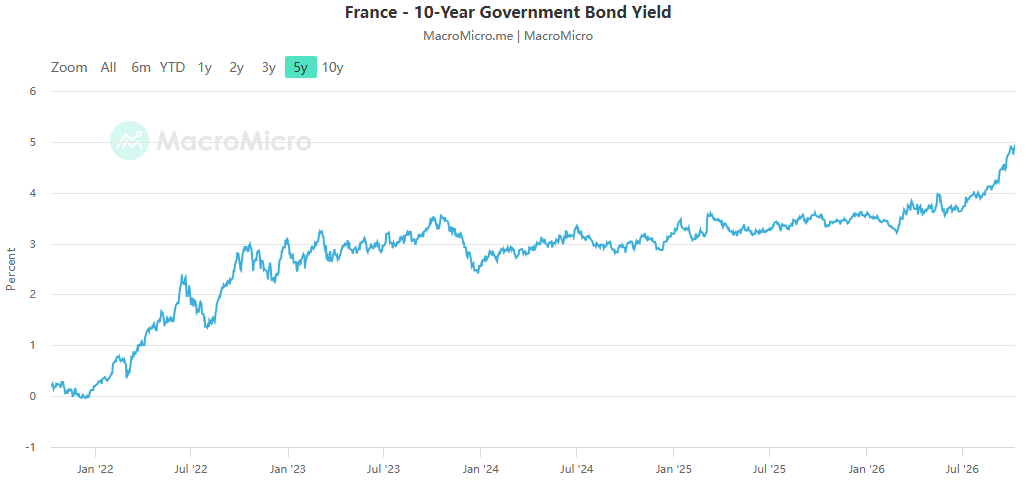
ACE Markets' monitoring shows that the recent sell-off in French bonds pushed the yield on 10-year French government bonds to 5%, a new high since 2002. The spread between Franco-German 10-year bond yields surged to its highest level since the European debt crisis, with risk premiums rising rapidly. High debt levels themselves will not immediately trigger a crisis, but interest rate risk is transforming into credit risk. When yields rise rapidly in a short period, market focus shifts from the level of financing costs to the long-term repayability of debt. This is the core psychological shift behind the current sharp widening of the Franco-German yield spread.
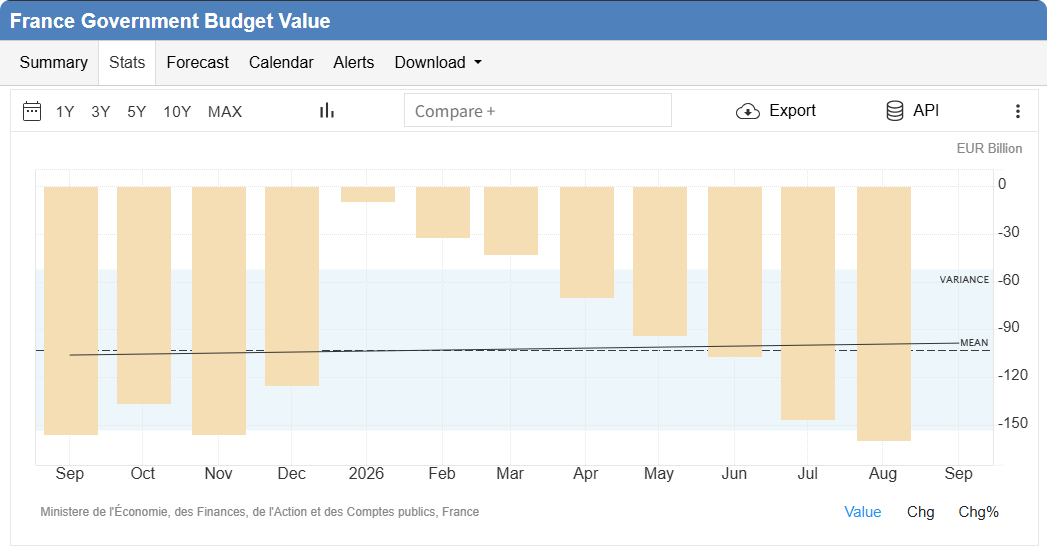
The root cause lies in a double whammy: a continuously expanding total debt and a sharp rise in refinancing costs. France's public debt has reached €3.6 trillion, approaching 120% of GDP, and its fiscal deficit this year is projected to reach 5.4%, significantly exceeding the EU's 3% threshold. France has not achieved a balanced budget since 1974, and its "anything goes" expansionary policies during successive crises have continuously driven up the debt level.
With global interest rates rising, a massive amount of debt issued during the era of low interest rates is maturing. Next year, French government bond issuance will reach a record high, and over $1 trillion in debt will need refinancing before 2030. Interest payments are already squeezing government budgetary space. The Governor of the Bank of France described this situation as a gradual strangulation of the economy: interest expenses continue to devour fiscal resources, squeeze public spending, and further weaken the space for economic recovery and fiscal reform.
The political cycle becomes the biggest variable: budget games and election constraints on fiscal reform.
The deteriorating fiscal figures are merely a symptom; what truly determines market confidence is the political feasibility of implementation. The French minority government has submitted a draft budget for 2027, planning to reduce the deficit ratio from 5.4% to 5% through spending cuts and moderate tax increases. However, even if the plan is fully implemented, the debt-to-GDP ratio will still continue to rise to 122%.
ACE Markets, combining political analysis with economic trends, points out that this budget faces significant practical obstacles: the government does not hold a majority in parliament, the 2027 presidential election is approaching, and anti-austerity protests are ongoing; some policy proposals from candidates on both the left and right wings lean towards further increasing government spending. Historically, France has repeatedly failed to meet its self-set fiscal targets, and if the budget fails to pass, France may once again rely on emergency legislation to keep itself running.
The market's concern is not about immediate debt defaults, but rather the policy deadlock in fiscal consolidation, with a lack of credible implementation paths in the long term. Furthermore, France is not an isolated case; Spain and Italy are also entering election cycles, leading to a simultaneous increase in fiscal policy uncertainty across many Eurozone countries, further amplifying sovereign debt volatility.
Risk spillover confirms: Spreading outwards from France, the bond market, exchange rate, and banking sector are all under pressure.
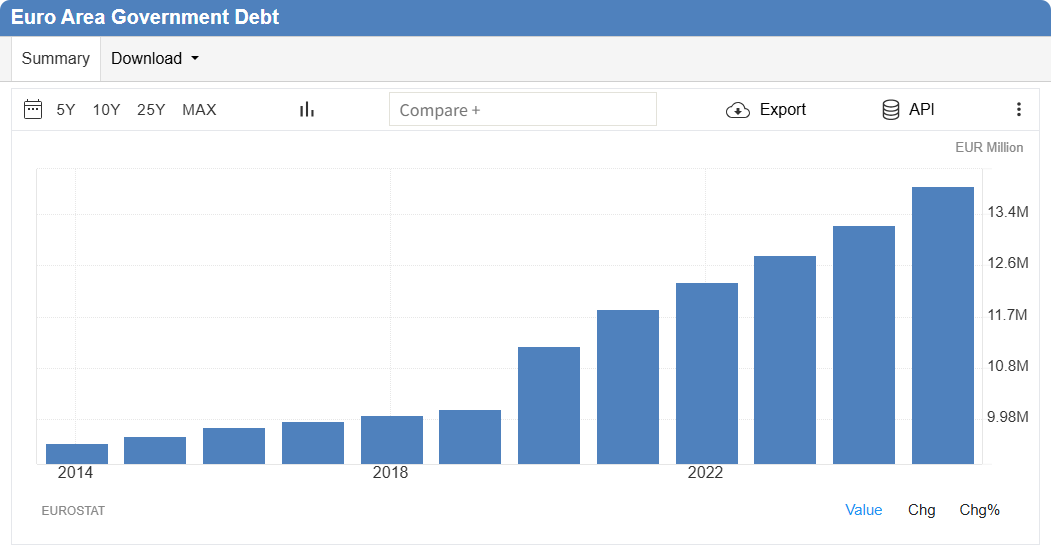
Thanks to France's systemic importance within the Eurozone, the risks will not be confined to its own borders, a point that can be compared to the transmission logic of the previous European energy shock. ACE Markets observed that during the sell-off of French bonds, the yield spreads of highly indebted member states such as Italy, Spain, Belgium, and Greece widened simultaneously, indicating that sovereign debt sustainability is no longer a national issue. The risks further spread outwards: the euro weakened due to fiscal risks; the European banking sector also experienced a significant correction, with the market concerned about potential unrealized losses on sovereign bonds held by the banking system.
It is noteworthy that this risk resonates with the European energy risks we previously assessed: Middle East unrest is driving up natural gas and crude oil prices, raising European inflation, which on the one hand compresses government finances and increases subsidy spending; on the other hand, it limits the European Central Bank's room for interest rate cuts, and the high-interest-rate environment, in turn, exacerbates the debt refinancing pressure on various countries. These two major risks—energy and fiscal—are mutually reinforcing, amplifying the overall vulnerability of the Eurozone.
The market exhibits a dual structure: amid panic selling, institutions are positioning themselves to capitalize on "golden opportunities created by mispricing."
The market did not experience a complete and indiscriminate exodus of European bonds; instead, it showed a clear divergence, a reality that many single-news interpretations easily overlook. ACE Markets' monitoring of fund flows revealed that large asset management institutions remained cautious about French sovereign bonds, unwilling to significantly increase their holdings before the election; however, a large amount of capital began to buy assets that had been unfairly punished by the market downturn, including peripheral sovereign bonds from Italy and Spain, as well as high-quality French corporate bonds and European investment-grade credit bonds.
The logic is clear: sovereign risk spillover led to a general decline in bonds, but the fundamentals of some companies are not tied to the French government's fiscal problems. Institutions generally believe that the current environment is not the same as the 2010-2012 European debt crisis. The Eurozone's institutional framework is sound, and the European Central Bank has the TPI transmission protection tool at its disposal, limiting the probability of a systemic collapse. Assets that were mistakenly sold off due to panic have room for recovery. However, funds are only making misaligned allocations and are not betting on a complete resolution of French sovereign debt risk.
The European Central Bank is caught in a dilemma; policy tools are not a panacea.
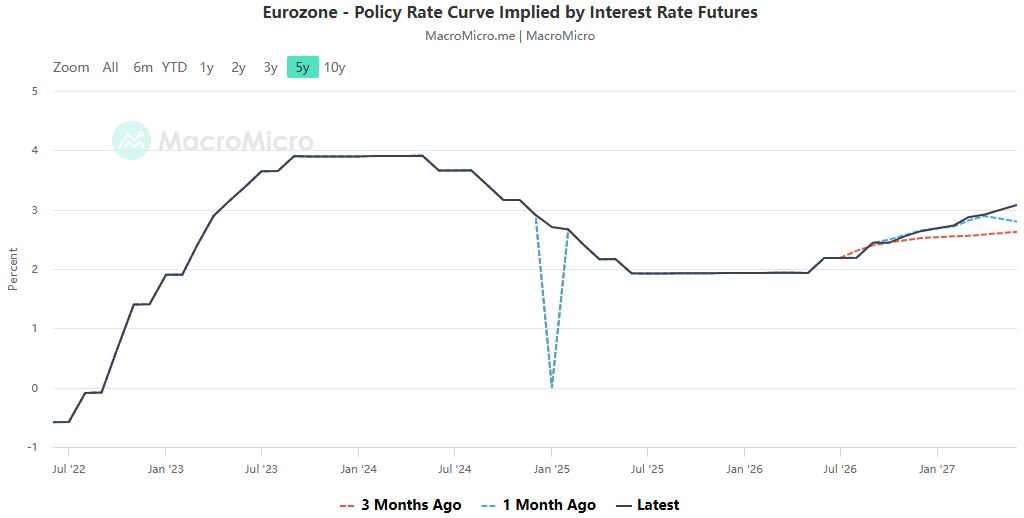
Amid multiple contradictions, the European Central Bank (ECB) is caught in a dilemma, simultaneously facing the dual pressures of inflationary pressures and sovereign debt market turmoil. On the one hand, driven by rebounding energy prices, Eurozone inflation remains high, theoretically preserving the possibility of further tightening; but on the other hand, soaring yields on government bonds in highly indebted countries, led by France, are themselves tightening financial conditions, which to some extent can substitute for the effect of interest rate hikes.
The market is pinning its hopes on the TPI transmission protection tool, but ACE Markets points out that the tool has strict requirements and is not an unconditional bailout. Activating the TPI requires a country to have sustainable debt and comply with the EU fiscal framework, among other conditions. France is currently in a period of excessive deficit, having exceeded its deficit limits for years. If the ECB easily activates the tool, the market will interpret it as bailing out member states' poor finances, damaging its credibility in combating inflation; if it remains inactive, it will allow sovereign risk to spread outwards. The Bank of France has also publicly stated that its responsibility is not to solve member states' budget problems. The ECB has very little room for maneuver.
ACE Markets Comprehensive Scenario Analysis
Based on a comprehensive cross-validation of fiscal data, political maneuvering, energy inflation, institutional holdings, and central bank tool constraints, we present our core judgment:
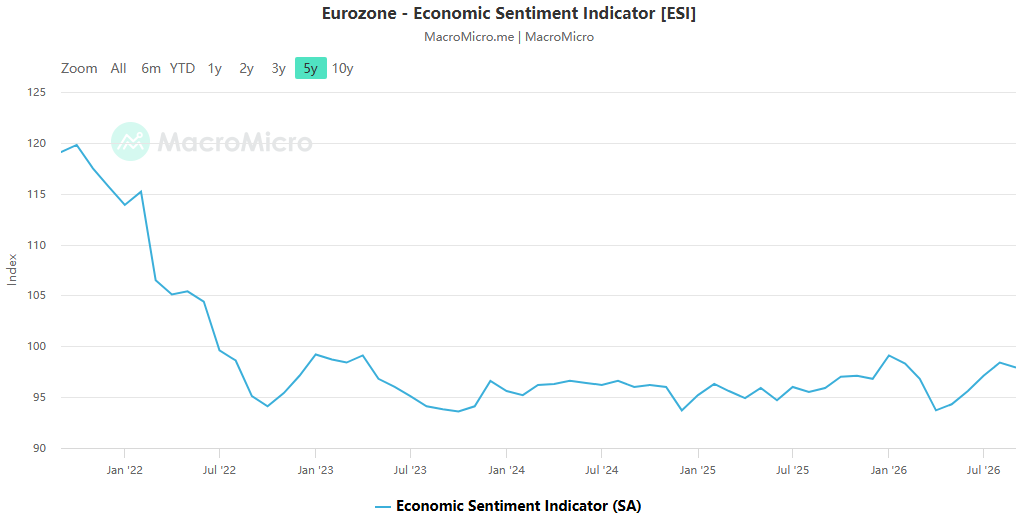
Baseline Scenario : The old version of the European debt crisis will not be a simple repeat. The system and crisis tools provide a bottom-line protection, but French fiscal reforms are hampered by politics, sovereign premiums will remain high for a long time, and high volatility in the bond market will become the norm.
Upside risk scenario : Budget proposal stalled, election expectations worsen, and Middle Eastern energy prices surge again, causing risks to spread rapidly outward and impact the euro and European banking sector.
Recovery scenario : If the fiscal budget is difficult to implement, coupled with lower-than-expected winter energy risks, foreign government bonds and European corporate bonds that have been oversold are expected to see a valuation recovery.
Going forward, it's crucial to closely monitor three key signals: the French parliamentary budget vote results, winter oil and gas price trends, and the European Central Bank's stance on the TPI tool. The market cannot view debt or energy as isolated variables; the current pressures on the Eurozone are a product of the interplay of geopolitical and energy shocks, the lingering effects of high interest rates, and fiscal easing during the election cycle.