

 summary:
Markets typically view the Feds policy divergence, the pullback in AI tech stocks, and the...
Markets typically view the Fed's policy divergence, the pullback in AI tech stocks, and the rebound in US Treasury bonds as three independent threads. ACE Markets, after cross-validation, believes these three are three manifestations of the same logic: the AI capital cycle has both driven up current inflation and the sell-off of US Treasury bonds, and its marginal cooling is reshaping interest rate hike expectations and asset pricing. Policy divergence, fluctuating interest rate hike probabilities, and the correction in stock-bond correlation all essentially revolve around the same core variable—whether AI's impact on inflation and the financing environment is waning. Looking only at CPI or only at tech stock performance will lead to misjudgments of policy and market trends.
The division in interest rate hike expectations is essentially a disagreement over the assessment of the "AI inflation effect."
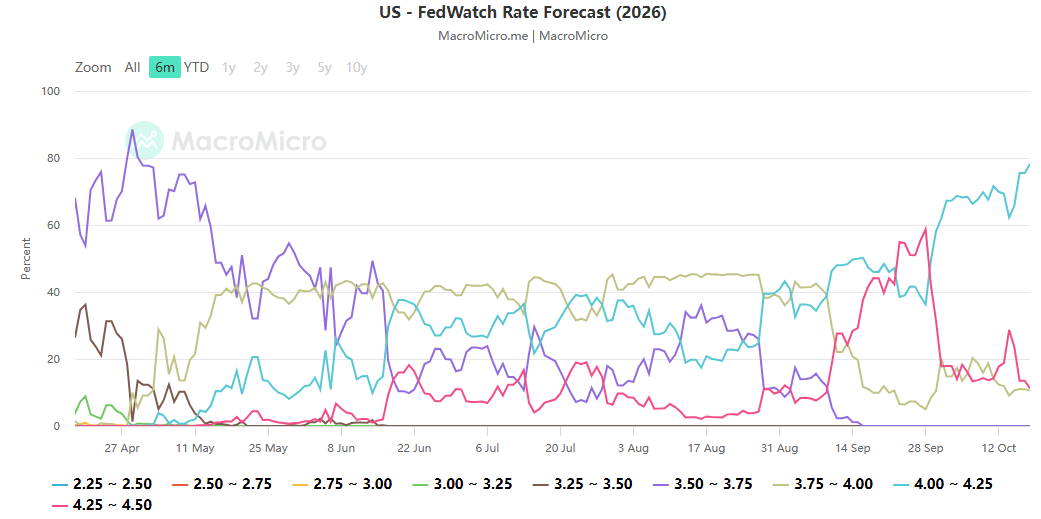
The market's pricing in the October decision is clearly divided: interest rate futures only factor in a 17% probability of a rate hike, with mainstream expectations remaining unchanged; however, top economists judge it to be nearly 50/50, with some institutions predicting consecutive rate hikes in October and December. The apparent divergence stems from higher-than-expected inflation, but at a deeper level, it reflects a divergence in assessments of the inflationary effects of the AI capital cycle.
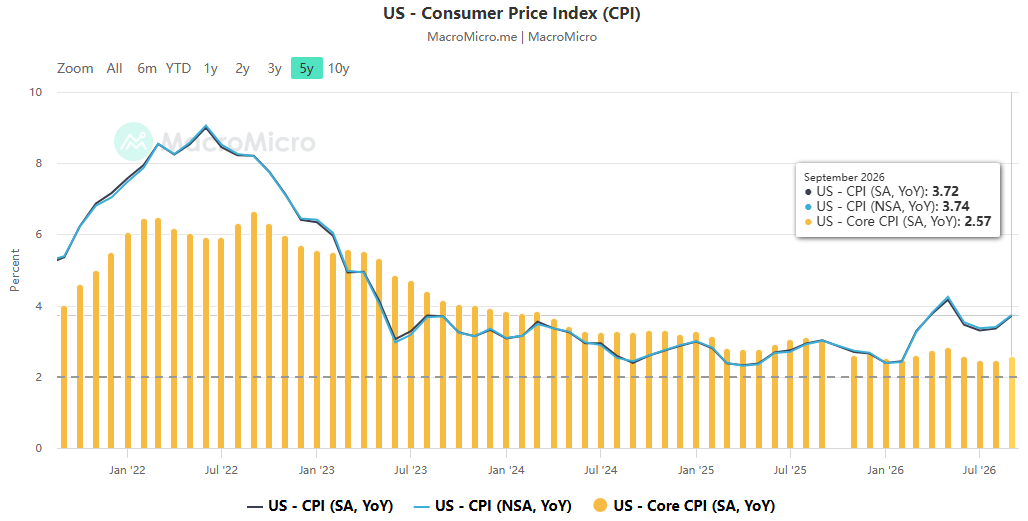
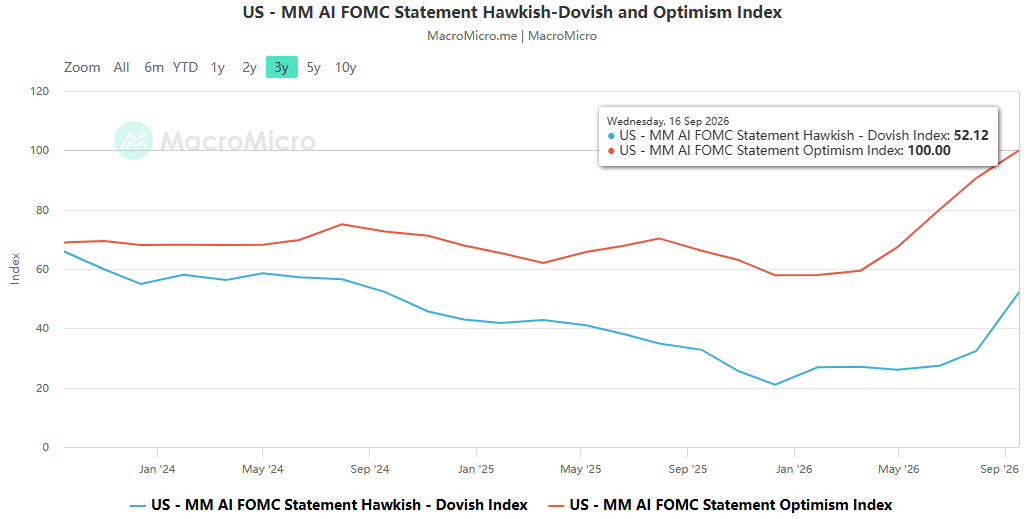
Hawks believe that the September CPI rose 3.7% year-on-year and PPI reached 6.3%, with pressure not limited to the energy sector. Inflation is spreading to a wider range of areas , driven by the continued growth of AI infrastructure – investment in computing power is boosting demand for chips, energy, and data centers, making it difficult for inflation to fall quickly . The current interest rate constraint of 3.75%–4% is insufficient, and continuous interest rate hikes are needed to rebuild policy credibility . On the other hand, the cautious camp also implicitly considers the AI variable . If the AI investment boom cools down at the margin, it will spontaneously tighten financial conditions, suppress demand and inflation. The Federal Reserve will not need to actively raise interest rates intensively , so it tends to lengthen the interval between rate hikes and wait for more data – they are not only observing the CPI, but also the actual trend of AI capital expenditure.
Warsh's refusal to provide advance guidance at the IMF annual meeting was not simply due to "data reliance," but rather because the AI cycle is at a turning point, a period of controversy and uncertainty. The timing of the election is only a secondary factor; the core of the internal disagreement lies in the differing assessments of the AI inflationary effect, and is the fundamental reason why the policy uncertainty in this round far exceeds that of the past.
The inverse trend in stocks and bonds is a result of advance pricing and self-correction of the "AI → interest rate hike" logic.
The Nasdaq 100 fell 5.5% in a single week, and the 10-year US Treasury yield fell 17 basis points in the same period, which is consistent with changes in policy expectations.
Self-correction expected : After the release of inflation data, the probability of an October rate hike once rose to nearly 50%, but quickly fell back as the AI sector continued to sell off. The market is pricing in: AI asset decline → rising financing costs, decreased willingness to spend capital → cooling demand → easing inflation → Fed slowing tightening. The adjustment in the AI sector itself is playing a "rate hike-like" role in tightening financial conditions, partially substituting for policy actions.
Easing supply and demand pressures : One of the key drivers of the seven-month consecutive sell-off in US Treasuries was the large-scale corporate bond issuance driven by the AI boom, competing with government bonds for funds—investment-grade corporate bond issuance has increased by 29% year-on-year, with a large portion concentrated in computing power and technology infrastructure. As AI trading weakens and credit bonds issued by computing power companies like CoreWeave decline, both the willingness and capacity of companies to issue bonds have decreased, marginally easing competition for US Treasuries. This is the fundamental support for the rebound in US Treasuries, rather than simply driven by safe-haven funds.
Increased positions, but not the primary reason : The massive liquidation of short positions in US Treasuries by CTAs amplified the decline in yields, but the trigger was still the expectation correction brought about by the waning AI hype. The collective emphasis by industry giants on the long-term prospects of AI ironically confirms the growing market skepticism regarding their capital returns and investment pace.
The rebound is unlikely to indicate a trend reversal; two forces are still locked in a struggle.
While the safe-haven function of US Treasury bonds has returned in stages, it is still too early to determine whether the bear market has ended or the tightening cycle has ended. Any unexpected turn of events could quickly reverse the market trend.
Upside risks : If AI only experiences a short-term pullback and capital expenditure accelerates again, coupled with Middle East geopolitical tensions pushing up energy prices, inflation will gain renewed upward momentum, potentially leading to interest rate hikes this year or even a resumption of intensive tightening, with US Treasury yields challenging previous highs again. Two sets of data provide cross-support: the energy component remains a significant driver of CPI, and oil prices can quickly transmit to inflation expectations; corporate bond supply remains high, and once risk appetite recovers, the crowding-out effect on US Treasuries will immediately reappear.
Downside risks : If AI investment contracts substantially, demand cools rapidly, and inflation eases, the Federal Reserve may not only stop raising interest rates but even shift towards an easing stance. However, evidence for this scenario is insufficient—giants are still increasing long-term investments, and the decline in capital expenditure remains largely an expectation, not yet reflected in inflation data.
Baseline Scenario : The AI cycle fluctuates at high levels, inflation is sticky but not out of control, interest rates remain unchanged in October but the option of a rate hike this year is retained, and US Treasury yields fluctuate repeatedly within a high range. There are structural opportunities in oversold high-rated corporate bonds and short-term US Treasuries, while long-term bonds remain under pressure from both fiscal supply and inflation expectations.
The interconnected logic of the global high-interest-rate environment
The chain of "capital cycle → inflation → central bank policy → sovereign debt yield" is universally applicable: Middle East geopolitical conflicts simultaneously drive up energy prices in Europe and the US, intensifying the dual tightening pressure on the Federal Reserve and the European Central Bank, jointly raising the global interest rate center; the yields of US Treasury bonds pushed up by US AI capital expenditures are transmitted outwards, exacerbating the refinancing pressure on highly indebted Eurozone countries such as France and pushing up sovereign debt spreads; the risk aversion sentiment arising from the fermentation of European sovereign debt risks has also led to a period of return to US Treasuries, forming a cross-market two-way linkage. Viewing any market or variable in isolation will underestimate the resilience of this round of global high interest rate cycle.
Summarize
The core contradiction is not "inflation data determines whether to raise interest rates," but rather the dynamic interplay between AI capital cycles, inflation stickiness, and the Federal Reserve's policy credibility: AI is both an inflation driver and a variable that can self-correct; policy disagreements are essentially differences in judgments about the direction of this variable; and the rebound in US Treasury bonds and the correction in tech stocks are the market's advance pricing of the turning point.
ACE Markets adheres to multi-threaded cross-validation, penetrating surface price fluctuations to reconstruct the complete transmission chain of "AI—Inflation—Policy—Assets". Going forward, it will focus on tracking three key signals : AI company capital expenditures and credit bond performance, the Fed's forward guidance for the October meeting, and marginal changes in crude oil and core inflation.